Spine
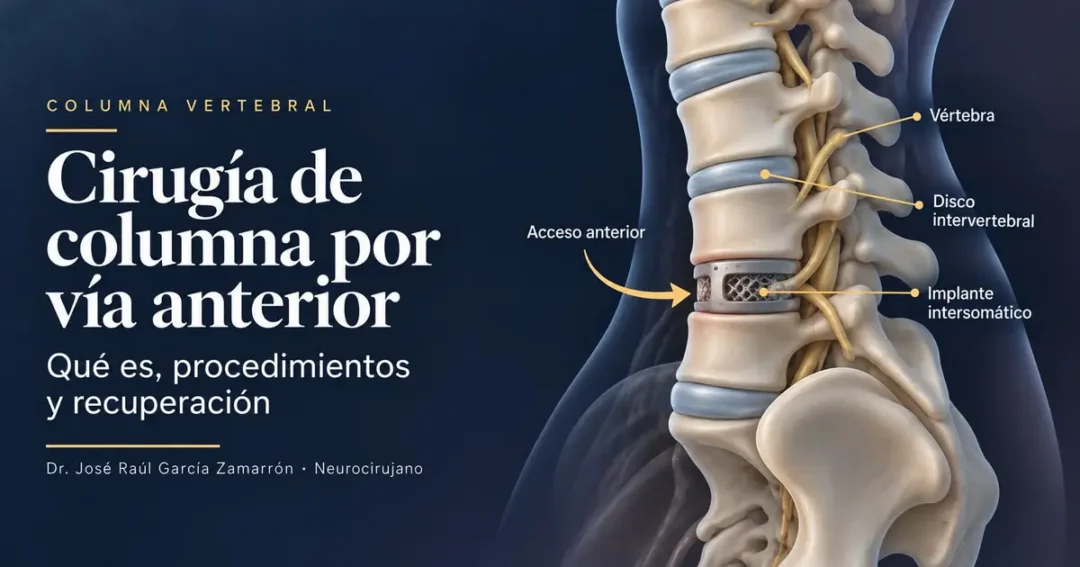
Anterior spine surgery is an approach that reaches the spine from the front of the body —through the front of the neck or through the abdomen— rather than from the back. This access allows the surgeon to treat the intervertebral disc directly and to relieve compressed nerve structures and, by preserving the back muscles, it often supports a smoother recovery. It is one of the procedures in which Dr. José Raúl García Zamarrón, a brain and spine neurosurgeon near El Paso, in Ciudad Juárez, specializes.
This guide explains what anterior spine surgery is, when it is indicated, which procedures it includes, how it differs from the posterior approach, and what recovery looks like.
Contents
- What anterior spine surgery is
- When it is indicated
- What is evaluated before surgery
- Anterior vs. posterior approach
- Main anterior procedures
- ALIF, OLIF, and XLIF: routes for lumbar fusion
- Fusion or artificial disc
- How the surgery is performed
- Advantages and considerations
- Recovery and follow-up
- The spine surgery specialist
- Questions for your consultation
- Frequently asked questions
The anterior approach reaches the spine from the front to treat the disc and free the nerves
Anterior spine surgery is a surgical approach that reaches the spine from the front of the body. In the cervical spine, access is made through a natural crease at the front of the neck; in the lumbar spine, through the abdomen. From that front, the surgeon works directly on the intervertebral disc (the structure that cushions between two vertebrae) and on the areas pressing on the spinal cord or nerve roots.
The defining feature of this approach is direct access to the front of the spine without separating the back muscles, which stay intact. Once the damaged disc is removed, the space is restored with an implant or graft that maintains the height between the vertebrae and, depending on the case, promotes fusion of that segment or preserves its mobility.
It is indicated when the compression comes from the front of the spine
The anterior approach is chosen when the condition is located at the front of the spine and that access offers the best route to treat it. The specialist defines the indication after assessing the symptoms, the physical examination, and the imaging studies. Common reasons include:
- A cervical or lumbar herniated disc that compresses a nerve root or the spinal cord and does not respond to conservative treatment.
- Degenerative disc disease, when wear causes pain or instability.
- Cervical myelopathy or radiculopathy (compression of the spinal cord or a nerve root that causes pain, numbness, or loss of strength).
- Certain deformities, instabilities, or the need to restore height and alignment between vertebrae.
Not every spine condition requires surgery, and not every case that does is treated through the anterior approach. If you have a spine diagnosis or symptoms that will not ease, an evaluation with Dr. José Raúl García Zamarrón can define the source of the problem and whether the anterior approach is the right one for your case. You can read more in the article on spine surgery.
What is evaluated before deciding on anterior surgery
Before recommending anterior surgery, the specialist performs an assessment that combines the clinical history, the neurological examination, and imaging studies. That assessment drives both the decision to operate and the choice of approach.
Clinical history and symptoms
When they started, how they are changing, and which treatments have been tried.
Neurological examination
Strength, sensation, reflexes, and maneuvers that pinpoint the affected level.
Imaging studies
MRI (shows the disc and the compression), CT (details the bone), and X-rays, including dynamic views that assess stability.
Clinical-radiological correlation
Surgery is indicated when the imaging findings explain the symptoms and the examination.
In the lumbar spine, the anatomy of the large blood vessels is also assessed to plan the access. This evaluation defines not only whether surgery is advisable, but also which approach —anterior, lateral, or posterior— offers the best route for each case.
The anterior and posterior approaches are chosen based on where the compression comes from
The spine can be approached from the front (anterior) or from the back (posterior), and neither is superior in every case. The choice depends on where the lesion is, which structures need to be treated, and each patient's characteristics.
In some cases, treatment combines both approaches. The decision is part of individual surgical planning.
Anterior procedures vary by the level of the spine
The anterior approach groups several procedures. Which one applies depends on the level of the spine, the condition, and whether it is best to fuse the segment or preserve its movement.
Cervical spine
Anterior cervical discectomy and fusion (ACDF)
The damaged disc is removed from the front of the neck, the compressed nerve structure is freed, and the space is restored with an implant that fuses the two vertebrae.
Lumbar spine
Anterior lumbar interbody fusion (ALIF)
Through the abdomen, the lumbar disc is reached and removed, and a larger implant is placed to restore height and alignment. The side approaches (OLIF, XLIF) are part of minimally invasive surgery.
Alternative to fusion
Arthroplasty (artificial disc)
In selected cases, instead of fusing, an artificial disc is placed to replace the damaged one and preserve the movement of that spinal segment.
Wide decompression
Anterior corpectomy
When compression spans more than one level, part of a vertebral body is removed to free the spinal cord and rebuild the spine's support.
ALIF, OLIF, and XLIF: the routes for lumbar fusion
In the lumbar spine, interbody fusion (replacing the disc with an implant that joins two vertebrae) can be performed through different routes, and each is named for where the disc is accessed. All share the goal of removing the damaged disc and restoring height and alignment; they differ in the access.
| Technique | Access route | Characteristic |
|---|---|---|
| ALIF (anterior) | From the front, through the abdomen | Direct, wide access to the disc; allows large implants; preserves the back muscles |
| OLIF (oblique lateral) | Through an oblique corridor from the side | Minimally invasive; avoids opening the back and reduces manipulation of structures |
| XLIF / LLIF (lateral) | From the side (flank) | Minimally invasive; direct access to the disc from the side |
| TLIF / PLIF (posterior) | From the back | Posterior approach; useful when posterior decompression is also needed |
The choice depends on the level, the patient's anatomy, and the goal of the procedure. Dr. José Raúl García Zamarrón performs these approaches —anterior, oblique, lateral, and posterior— and defines the most appropriate route in each case.
Real case
Anterior lumbar fusion (ALIF) at L5-S1
Before · Diagnosis

One month after surgery · Result


Fusion or artificial disc: how they differ and how the choice is made
The difference between fusing and placing an artificial disc lies in the goal: fusion stabilizes the segment by joining two vertebrae, while the artificial disc (arthroplasty) preserves the movement of that level.
Fusion removes the disc and joins the vertebrae with an implant; it is indicated in cases of instability, deformity, involvement of several levels, or significant joint wear. Arthroplasty replaces the damaged disc with a prosthesis that keeps the movement, and it is considered in selected cases, especially when the posterior joints are preserved.
One point often discussed is adjacent segment disease: fusing one level can place more demand on the neighboring ones over time. Arthroplasty aims to reduce that effect by preserving movement. Neither option is superior in every case; the choice responds to the condition, the level, and each patient's characteristics.
How anterior spine surgery is performed
Anterior surgery is performed under general anesthesia and, depending on the level, through an incision in the neck or the abdomen. The surgeon advances between the natural tissue planes until the front of the spine is exposed.
Once the affected level is exposed, the damaged disc is removed and the compressed nerve structure is freed. The implant for each case —fusion or motion-preserving— is then placed, and its position is verified with imaging during the surgery. In the lumbar spine, the approach is often performed together with an access surgeon to manage the large blood vessels.
Precision during the operation is supported by operating-room technology: real-time imaging to verify implant position, and neurophysiological monitoring to watch nerve function. That is why the infrastructure of the hospital where the surgery takes place is part of the decision when choosing where to be treated. You can learn about these resources in the article on technology for brain and spine surgery..
Advantages and considerations of the anterior approach
The anterior approach offers concrete benefits for the patient and, like any surgery, involves considerations that the specialist explains during the evaluation.
Advantages of the anterior approach
- ✓The back muscles are preserved
- ✓It allows height and alignment between vertebrae to be restored
- ✓Small incisions and, in the neck, through a natural crease that is barely visible
- ✓It often supports a smoother recovery, since the back muscles are not damaged
- ✓A hospital stay that is usually short, depending on the case
Among the considerations, the anterior access sits near neighboring structures that require careful handling: in the neck, the route passes close to the windpipe, the esophagus, and the vocal cords, so temporary discomfort when swallowing or passing changes in the voice can occur; in the lumbar region, the proximity to the large blood vessels is the reason an access surgeon often takes part.
The specific risks of each case, their likelihood, and the measures to reduce them are part of the conversation before surgery. A well-indicated approach performed in a hospital with the right infrastructure is the foundation of a safe procedure.
Recovery and follow-up after anterior spine surgery
Recovery depends on the level treated, the procedure performed, and each patient's health. Preserving the back muscles often supports a gradual return to activity, always within the specialist's guidance.
In general terms, the process tends to follow these stages:
First hours
Monitoring and early mobilization
After surgery, the patient stays under observation while pain is controlled. Early mobilization is part of the process when the specialist indicates it.
HOSPITAL STAY
A usually short stay
In many cases the hospital stay is short. Its length depends on the procedure, the level treated, and each patient's course.
Gradual return
Returning to activity in stages
Activity is resumed gradually, respecting the guidance on exertion and posture. In some cases, rehabilitation is added to support recovery.
Follow-up care
Check-ups with imaging studies
Follow-up visits and imaging studies confirm how the implant and the fusion are progressing. The specialist schedules each check-up.
Anterior spine surgery calls for a specialist with specific training
The anterior approach demands command of the anatomy of the neck and abdomen, of implant technique, and of the planning for each level. That is why it is best performed by a specialist with specific training and experience in spine surgery. An evaluation defines whether your case benefits from this approach and which procedure applies.
The specialist's spine surgery training
Dr. José Raúl García Zamarrón is a brain and spine neurosurgeon at Hospital Angeles Ciudad Juárez —minutes from El Paso, just across the border— board-certified by the Mexican Council of Neurological Surgery. He holds a master's degree in spine surgery from Universidad CEU Cardenal Herrera (Spain) and is a member of AO Spine, the leading international organization in spine surgery. He performs more than 200 brain and spine surgeries a year, with a focus on minimally invasive approaches.
Dr. García Zamarrón also treats complex cases and spine revision surgery,which require detailed study and careful planning. Each case is assessed individually to define the best option.
If you have a spine diagnosis and want to know whether the anterior approach is right for your case, an evaluation with the specialist will give you concrete answers. You can also read the guide on how to choose the right neurosurgeon for your case..
Questions worth asking at your consultation
Arriving at your evaluation with clear questions helps you understand your case and make an informed decision. These are useful when discussing possible anterior spine surgery:
For your consultation
- Does my case benefit from the anterior approach, or is another approach better?
- Would it be treated with fusion or with an artificial disc, and why?
- How many levels of the spine would be operated on?
- At which hospital would the surgery take place, and what technology does it have?
- What result is realistic to expect, and what would recovery look like?
- What specific risks does my case carry, and how are they reduced?
Frequently asked questions about anterior spine surgery
Does anterior surgery hurt more than the posterior approach?
Not necessarily. By reaching the spine from the front, the anterior approach preserves the back muscles, which is often associated with less pain in that area after surgery. In the cervical spine, temporary discomfort when swallowing can occur. Pain control is part of the postoperative plan in every case.
Will I have a large scar?
The incisions in the anterior approach are small. In the neck, access is made through a natural crease, which helps the scar be barely visible over time. The cosmetic result depends on each person and on postoperative care.
Will I lose mobility in my neck or back?
It depends on the procedure. Fusion joins two vertebrae, which limits the movement of that specific segment, usually without a noticeable impact on overall mobility. When possible, arthroplasty with an artificial disc preserves the movement of that level. The specialist explains which option applies to your case.
What is the difference between fusion and an artificial disc?
Fusion removes the disc and joins the two vertebrae with an implant to stabilize the segment. The artificial disc replaces the damaged disc while preserving the movement of that level. Both options have precise indications, and the choice depends on the condition, the level, and the patient's characteristics.
How long does recovery take?
Recovery time varies depending on the level treated, the procedure, and each person's health. The return to activity is gradual and follows the specialist's guidance on exertion and posture. Follow-up with imaging studies accompanies that process.
Will I need a collar or a brace after surgery?
It depends on the procedure and the level treated. Some cervical surgeries call for a soft collar for comfort for a time, and certain lumbar cases a support brace. It is not always necessary; the specialist indicates whether it applies in your case and for how long.
Can fusion affect the neighboring discs over time?
Fusion joins a segment and, over the years, can increase the demand on the adjacent levels, a phenomenon known as adjacent segment disease. It does not happen in every case. When possible and indicated, arthroplasty with an artificial disc aims to preserve movement and reduce that demand. Follow-up allows the course to be monitored.
What is percutaneous instrumentation?
It is the placement of screws and other implants through small incisions, rather than a wide opening. It is part of minimally invasive spine surgery and, in selected cases, is combined with the anterior or lateral approaches. Its use depends on the condition and the level to be treated.
Where can I have anterior spine surgery near El Paso?
Dr. José Raúl García Zamarrón, a neurosurgeon board-certified by the Mexican Council of Neurological Surgery, with a master's degree in spine surgery (Spain) and a member of AO Spine, sees brain and spine patients at Hospital Angeles Ciudad Juárez —minutes from El Paso, across the border— at Av. Campos Elíseos 9371, Office 795. You can schedule a consultation by phone at +52 656 227 1963 or by WhatsApp at +52 656 657 7818.
Consultation & Evaluation
An evaluation will define the best approach for your spine
An evaluation brings clarity about your diagnosis, the treatment options, and whether your case benefits from an anterior approach.
Schedule Your Consultation Message Us on WhatsApp
Dr. José Raúl García Zamarrón —Neurosurgeon · Brain & Spine
Hospital Angeles Ciudad Juárez · minutes from El Paso, across the border
Av. Campos Elíseos 9371, Office 795, Col. Campos Elíseos, C.P. 32420
Phone 656 227 1963 WhatsApp 656 657 7818
Monday to Friday, 9:00 AM–5:00 PM · Saturdays, 9:00 AM–12:00 PM
Keep Reading
Medical Review
Dr. José Raúl García Zamarrón
Neurosurgeon · Brain & Spine · Ciudad Juárez, Chihuahua
Professional License 6241285 · Specialty License 10138902
Board-certified by the Mexican Council of Neurological Surgery · Member of AO Spine and EANS
Learn about the specialist’s background →
Last updated: November 2026.
This content is for informational and educational purposes only. It does not replace a medical consultation, diagnosis, or personalized treatment. If you have neurological symptoms, see a specialist. If they are sudden or severe, seek emergency medical care.