
Brain & Nervous System
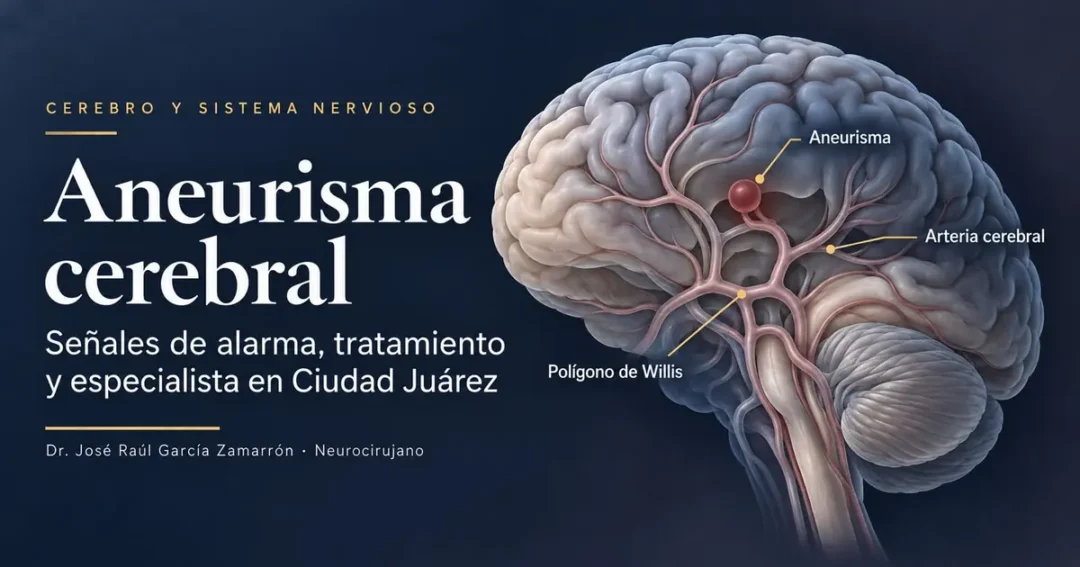
A cerebral aneurysm is an abnormal bulge in the wall of an artery in the brain,much like a small balloon forming at a weakened spot in the vessel. Most cause no symptoms and stay stable, but when one ruptures it becomes a medical emergency that needs immediate attention. That is why a specialist's role is twofold: to carefully assess the risk of an unruptured aneurysm, and to act quickly when a rupture has already happened.
This guide explains what a cerebral aneurysm is, which warning signs call for emergency care, how it is diagnosed, what treatment options exist, and when it makes sense to see a specialist near El Paso, in Ciudad Juárez.
Contents
- Warning signs: when to seek emergency care
- What a cerebral aneurysm is
- Symptoms of an unruptured aneurysm
- What happens when an aneurysm ruptures
- Causes and risk factors
- When screening is worth considering
- How it is diagnosed
- Types of Brain Aneurysm
- Treatment options
- When to see a cerebral aneurysm specialist
- Recovery and follow-up
- How to lower the risk of rupture
- Frequently asked questions
A ruptured aneurysm is a medical emergency that cannot wait
Before explaining what an aneurysm is and how it is evaluated, it helps to recognize the emergency first. When an aneurysm ruptures, blood spills around the brain —a condition called a subarachnoid hemorrhage (bleeding in the space surrounding the brain)— and every minute counts. If you or someone near you has any of these signs, don't wait for an appointment: call 911 or go to the nearest emergency room right away.
Go to the Emergency Room
- The worst headache of your life— sudden, severe, and unlike any other
- A sudden headache with nausea or vomiting
- A stiff neck
- Double vision, a drooping eyelid, or intense sensitivity to light
- Confusion, trouble speaking, or sudden weakness on one side of the body
- Loss of consciousness or a seizure
There is also a warning that should not be ignored: the so-called sentinel headache (a sudden, severe headache that can appear days or weeks before a larger rupture). A sudden, severe headache that is different from your usual ones deserves medical evaluation, even if it eases on its own.
A cerebral aneurysm is a weakened area of an artery that balloons outward
A cerebral aneurysm forms when part of the wall of a brain artery weakens and bulges outward. The most common type is the saccular aneurysm (shaped like a small sac or berry), which tends to appear where arteries branch at the base of the brain, in a network of vessels known as the circle of Willis.
Most cerebral aneurysms are small, cause no symptoms, and stay stable over time. The meaningful risk is not that one simply exists, but the possibility that it may grow or rupture. Determining that risk in each case is precisely the specialist's job.
Having a cerebral aneurysm does not mean it will rupture. Many people live with a small, stable aneurysm that only requires monitoring. The decision to treat or monitor is made individually, weighing the size, the location, and each patient's characteristics.
Most unruptured aneurysms cause no symptoms at all
An unruptured aneurysm is often silent, which is why many are found incidentally on an imaging test ordered for another reason. This absence of symptoms is exactly why risk assessment matters so much: it allows decisions to be made before a complication occurs.
When an aneurysm reaches a certain size, it can press on nearby structures and produce signs worth knowing. Among them: pain above or behind one eye, double or blurred vision, a drooping eyelid, one pupil larger than the other, or numbness on one side of the face. These symptoms are not an emergency in the way a rupture is, but they do warrant prompt specialist evaluation.
What happens when a cerebral aneurysm ruptures
When an aneurysm ruptures, blood spills into the space surrounding the brain, causing a subarachnoid hemorrhage — a life-threatening emergency. The time it takes to reach care has a decisive effect on the outcome.
The blood and the rise in pressure inside the skull can damage brain tissue. In the days that follow, there are additional risks the medical team monitors closely, such as a new bleed or narrowing of the arteries (vasospasm), which reduces blood flow to the brain. For this reason, a rupture is managed in a hospital setting with the right resources.
At any sign of a possible rupture —especially the worst headache of your life, of sudden onset— the instruction is to call 911 or go to the nearest emergency room immediately, as detailed in the WARNING SIGNS at the start of this guide.
Certain factors raise the chance of developing or rupturing an aneurysm
A cerebral aneurysm is linked to a combination of factors. Some cannot be changed, such as family history; others depend on habits and on managing certain conditions. Knowing them helps identify who is worth evaluating and how to lower the risk when possible.
| Factors you can control | Factors you cannot change |
|---|---|
| High blood pressure (hypertension) | Family history of aneurysm |
| Smoking | Older age |
| Heavy alcohol use | Female sex |
| Use of stimulants such as cocaine | Polycystic kidney disease and certain connective tissue disorders |
Family history deserves a separate note: when two or more first-degree relatives have had a cerebral aneurysm, it is worth discussing with a specialist, who will assess whether a screening study is indicated.
When screening is worth considering
Screening to look for aneurysms is not recommended for the general population, but it is worth considering in people with a higher chance of having one. The decision is made by the specialist after reviewing your history.
- Having two or more first-degree relatives with a history of cerebral aneurysm.
- Polycystic kidney disease (an inherited kidney condition).
- Certain connective tissue disorders that weaken artery walls.
If any of these apply to you, raising it during an evaluation helps define whether a study is indicated and how often it should be repeated.
A cerebral aneurysm is diagnosed with imaging of the arteries
A cerebral aneurysm is confirmed by visualizing the arteries of the brain with imaging studies. The choice of test depends on the clinical situation: evaluating an emergency is not the same as studying an incidental finding in a person with no symptoms.
Test 01
CT angiography (CTA)
A CT scan with contrast that highlights the arteries. Fast and widely used in the ER to see the aneurysm and any bleeding.
Test 02
MR angiography (MRA)
An MRI that looks at the vessels without radiation. Useful for studying and monitoring unruptured aneurysms.
Test 03
Digital subtraction angiography
The most detailed study of the arteries; the reference standard for planning treatment and defining the aneurysm's shape and neck.
Cerebral aneurysms are classified by shape, size, and location
Cerebral aneurysms are not all alike, and their classification guides both the risk estimate and the choice of treatment. Shape is the first feature described.
| Type | Characteristic |
|---|---|
| Saccular (berry-shaped) | The most common; forms where arteries branch |
| Fusiform | A bulge around the entire circumference of the artery, with no defined neck |
| Mycotic (infectious) | Uncommon; linked to an infection that weakens the artery wall |
Size (from small up to the so-called giant aneurysms) and location —in the anterior or posterior circulation of the brain— complete the description. Both influence the risk of rupture and, therefore, what the specialist recommends.
Treatment may be monitoring, surgery, or a procedure from inside the artery
Not every cerebral aneurysm requires intervention. The choice between monitoring or treating, and the method itself, are defined individually: the aneurysm's size and location, whether it has ruptured, the patient's age and health, and personal and family history all weigh in. There are three main paths.
Active monitoring
For small, stable aneurysms with a low risk of rupture, the specialist may recommend periodic imaging and management of risk factors, such as blood pressure and smoking. Monitoring is an active medical decision, not an absence of treatment.
Microsurgical Clipping
Through surgery, the neurosurgeon places a small clip across the neck of the aneurysm to seal it off from the circulation and keep it from filling with blood. It is a well-established procedure supported by operating-room technology, described in the article on technology for brain surgery..
Endovascular treatment
This is done from inside the artery, reaching the aneurysm through a catheter inserted into a vessel, usually in the groin or wrist. There, the aneurysm is packed with tiny coils, or a device is placed to divert blood flow, so the aneurysm no longer receives pressure. It is a less invasive technique used in selected cases.
Both clipping and endovascular treatment have precise indications; neither is superior in every case. The choice responds to the characteristics of the aneurysm and the patient, and is part of the specialist evaluation. You can learn more on the cerebral aneurysm treatment page..
A cerebral aneurysm specialist assesses the risk and defines the best course for each case
The specialist to evaluate a cerebral aneurysm is a neurosurgeon with experience in vascular disease of the brain. Their role is not limited to operating: they assess the risk of rupture, weigh the options —monitoring, clipping, or endovascular treatment— and guide the decision with clear information. It makes sense to see a specialist when an aneurysm is found incidentally, when there is a family history, or with symptoms that suggest compression, such as double vision or a drooping eyelid.
The specialist's neurovascular training
Dr. José Raúl García Zamarrón is a brain and spine neurosurgeon at Hospital Angeles Ciudad Juárez —minutes from El Paso, just across the border— board-certified by the Mexican Council of Neurological Surgery. He completed international training in vascular surgery at Beneficência Portuguesa de São Paulo, Brazil, focused on the neurovascular approach —the diagnosis and surgical treatment of vascular diseases of the central nervous system— combining microsurgical and endovascular techniques for brain and spinal conditions. He performs more than 200 brain and spine surgeries a year and integrates operating-room technology into the evaluation and treatment of cerebral vascular disease.
A timely evaluation turns uncertainty into a concrete plan: knowing what type of aneurysm you have, what risk it represents in your case, and which course —monitoring or treatment— is the most appropriate. If you would like guidance on how to choose the right specialist, see the guide on how to choose the right neurosurgeon for your case..
Recovery and follow-up after treatment
Recovery after treatment of an aneurysm depends on whether it was treated preventively or after a rupture, on the method used, and on each patient's health. There is no single path, which is why the plan is defined individually.
In general terms, the process tends to follow these stages:
First hours and days
Close monitoring
After treatment, the patient stays under observation to manage pain and watch the course of recovery. The length of stay depends on the method used and on whether the aneurysm was treated preventively or after a rupture.
Follow-up studies
Imaging to confirm the result
Imaging of the arteries is done to confirm that the aneurysm was excluded from the circulation and that the treatment met its goal.
Depending on the case
Rehabilitation
Some patients, especially after a rupture, need physical, speech, or occupational rehabilitation to recover affected functions.
Follow-up care
Periodic check-ups
The specialist schedules imaging check-ups over time to watch the treated area and catch any change early. Control of factors such as blood pressure also continues.
How to lower the risk of an aneurysm rupturing
Although not every factor is within your control, several habits and the management of certain conditions help lower the risk of rupture. No single measure eliminates it completely, but together they make a difference.
- Control your blood pressure. Hypertension is one of the most important modifiable factors.
- Quit smoking. Smoking is linked to both the formation and the rupture of aneurysms.
- Moderate alcohol and avoid stimulants such as cocaine, which cause sharp spikes in blood pressure.
- Keep your scheduled check-ups once an aneurysm is known, so it can be monitored in time.
Frequently asked questions about cerebral aneurysms
Does a cerebral aneurysm always rupture?
No. Many aneurysms, especially small and stable ones, never rupture and only require monitoring. The risk of rupture depends on the size, the location, and each person's characteristics. That is why a specialist's evaluation is what defines whether to monitor or treat.
Can you live with a cerebral aneurysm without surgery?
Yes, in many cases. When an aneurysm is small, stable, and low-risk, the specialist may recommend monitoring with periodic imaging and management of factors such as blood pressure and smoking, without the need for surgery. The decision is reviewed at each follow-up.
What is the difference between clipping and endovascular treatment?
Clipping is surgery in which a clip is placed across the neck of the aneurysm to seal it off from the circulation. Endovascular treatment is done from inside the artery, with a catheter, packing the aneurysm with coils or diverting blood flow with a device. Neither is superior in every case: the choice depends on the characteristics of the aneurysm and the patient.
Does a severe headache mean I have an aneurysm?
Most headaches are not caused by an aneurysm. However, a sudden, severe headache unlike any other —described as the worst of your life— can signal the rupture of an aneurysm and is a medical emergency. With that kind of headache, call 911 or go to the nearest emergency room immediately.
Are cerebral aneurysms hereditary?
There can be a family component. When two or more first-degree relatives have had a cerebral aneurysm, it becomes more important to discuss it with a specialist, who will assess whether screening is advisable. Having an affected relative does not mean you will develop one, but it does justify an evaluation.
Where can I see a cerebral aneurysm specialist near El Paso?
Dr. José Raúl García Zamarrón, a neurosurgeon board-certified by the Mexican Council of Neurological Surgery with international training in neurovascular surgery at Beneficência Portuguesa de São Paulo, Brazil, sees brain and spine patients at Hospital Angeles Ciudad Juárez —minutes from El Paso, across the border— at Av. Campos Elíseos 9371, Office 795. You can schedule a consultation by phone at +52 656 227 1963 or by WhatsApp at +52 656 657 7818.
Can stress or physical exertion rupture an aneurysm?
A sharp rise in blood pressure, from very intense exertion or a situation of great stress, can be associated with rupture in an aneurysm that is already present; even so, most ruptures have no identifiable trigger. Controlling blood pressure and avoiding tobacco are more decisive than avoiding all exertion. Your specialist will tell you whether any restriction applies in your case.
Can I fly if I have a cerebral aneurysm?
In general, having an unruptured, stable aneurysm does not prevent you from flying, since the cabin is pressurized. Even so, it is worth discussing with your specialist, especially if the aneurysm is high-risk or if you were recently treated, so you receive guidance suited to your case.
Can an aneurysm come back after treatment?
The imaging check-ups done after treatment exist precisely to confirm that the aneurysm was excluded from the circulation and to detect any residual filling or a new aneurysm. That is why follow-up with periodic studies is part of the treatment, and its frequency is defined by the specialist.
How long is recovery after treatment?
Recovery varies depending on whether the aneurysm was treated preventively or after a rupture, the method used, and each person's health. It usually includes a period of observation, follow-up imaging, and, in some cases, rehabilitation. The specialist defines the timeline and the follow-up plan individually.
Consultation & Evaluation
If you've been told you have a cerebral aneurysm, an evaluation brings clarity
Knowing what type of aneurysm you have, what risk it represents in your case, and whether to monitor or treat is the first step toward an informed decision — with peace of mind.
Schedule Your Consultation Message Us on WhatsApp
Dr. José Raúl García Zamarrón —Neurosurgeon · Brain & Spine
Hospital Angeles Ciudad Juárez · minutes from El Paso, across the border
Av. Campos Elíseos 9371, Office 795, Col. Campos Elíseos, C.P. 32420
Phone 656 227 1963 WhatsApp 656 657 7818
Monday to Friday, 9:00 AM–5:00 PM · Saturdays, 9:00 AM–12:00 PM
Keep Reading
Medical Review
Dr. José Raúl García Zamarrón
Neurosurgeon · Brain & Spine · Ciudad Juárez, Chihuahua
Professional License 6241285 · Specialty License 10138902
Board-certified by the Mexican Council of Neurological Surgery · Member of AO Spine and EANS
Learn about the specialist’s background →
Last updated: November 2026.
This content is for informational and educational purposes only. It does not replace a medical consultation, diagnosis, or personalized treatment. If you have neurological symptoms, see a specialist. If they are sudden or severe, seek emergency medical care.