
Patient Guide
Brain tumors are one of the most common reasons patients search for a neurosurgeon, and a new diagnosis often brings more questions than answers. This guide first answers the three most urgent questions, then walks you through the topic in detail so you can move forward with clarity.
What is a brain tumor? It is a mass of cells that grow abnormally inside the skull, in the brain, its membranes, the nerves, or glands such as the pituitary gland.
What symptoms can it cause? The most common are a new and worsening headache, seizures, vision changes, weakness, speech problems, or changes in behavior. Symptoms depend mainly on where in the brain the tumor is located.
Is it always cancer? No. Many brain tumors are benign, although some need treatment because of their location or growth rate.
If you or someone you love is facing this situation, we invite you to read the following information at your own pace.
Medically reviewed by Dr. José Raúl García Zamarrón, brain and spine neurosurgeon
In this guide
- What is a brain tumor?
- Is a brain tumor always cancer?
- What are the types of brain tumors?
- What are the symptoms of a brain tumor?
- When should I see a doctor?
- What causes brain tumors, and who is at risk?
- How is a brain tumor detected?
- What are the treatment options for a brain tumor?
- Does every brain tumor need surgery?
- What is recovery like after brain tumor surgery?
- Key takeaways
- Frequently Asked Questions
What is a brain tumor?
A brain tumor is an abnormal growth of cells inside the skull. It can form in the brain tissue itself, in the membranes that cover the brain, in the cranial nerves, or in glands such as the pituitary gland.
Normally, cells divide in an orderly way and are replaced only when needed. When that control is lost because of changes in their genetic material, cells multiply unchecked and form a mass.
Brain tumors are divided into two groups based on where they start:
- Primary brain tumors: they start in the central nervous system, meaning the brain, spinal cord, and their membranes. They can be benign or malignant.
- Secondary or metastatic brain tumors: they come from cancer in another organ, such as the lung or breast, whose cells reach the brain through the bloodstream. In adults, they are more common than primary brain tumors.
One feature makes brain tumors different: the skull is rigid and cannot expand. Any mass growing inside it takes up limited space.
That is why a tumor can raise intracranial pressure (the pressure inside the skull) or press on areas that control specific functions, even when the tumor is benign.
Is a brain tumor always cancer?
Not all brain tumors are cancer. Some are benign, although they may still need treatment because of their location or growth.
The word “cancer” is used for malignant tumors: those that grow quickly, invade surrounding tissue, and tend to come back after treatment. A benign brain tumor, by contrast, usually grows slowly and has clearer borders.
Doctors describe how each tumor behaves using the World Health Organization classification, which assigns a grade from 1 to 4 based on how the cells look under the microscope and on their molecular features:
| Grade | Typical behavior | Examples |
|---|---|---|
| Grade 1 | Benign, slow-growing, usually with well-defined borders | Most meningiomas, vestibular schwannoma |
| Grade 2 | Slow-growing, but able to invade nearby tissue and come back | Some astrocytomas and oligodendrogliomas, atypical meningiomas |
| Grade 3 | Malignant, with faster growth | Anaplastic astrocytoma, anaplastic meningioma |
| Grade 4 | Malignant and fast-growing; requires combined treatment | Glioblastoma |
Benign does not mean harmless
A benign brain tumor may need treatment even though it is not cancer. It does not spread to other organs, but inside the skull its growth can press on the optic nerves, blood vessels, or the areas that control movement and speech.
For this reason, the decision to treat does not depend only on whether a tumor is benign or malignant. Its size, location, growth rate, and symptoms also matter.
Can a benign tumor become malignant? In some cases, yes. Certain low-grade gliomas can progress to a higher grade over the years; in benign meningiomas, this change is uncommon. That is why follow-up imaging is part of treatment.
What are the types of brain tumors?
The most common types of brain tumors are meningiomas, gliomas, pituitary adenomas, vestibular schwannomas, and brain metastases. In total, there are more than one hundred types, classified by the cell or structure where they begin.
Meningioma
Meningioma is the most common primary tumor of the central nervous system, and in most cases it is benign. It starts in the meninges, the membranes that surround and protect the brain and spinal cord.
Because it grows from the surface inward, it usually causes symptoms by pressing on the brain rather than invading it. It is more common in women and in people over 50.
Gliomas
Gliomas are tumors that start in glial cells, which support, nourish, and protect neurons. Unlike meningiomas, they grow within the brain tissue and tend to infiltrate it, so their borders are less defined. They include several subtypes:
- Astrocytoma starts in astrocytes, star-shaped cells. It can be low-grade or high-grade.
- Oligodendroglioma starts in oligodendrocytes, which form the protective coating of nerve fibers. It usually grows slowly.
- Glioblastoma: the most common malignant primary brain tumor in adults. It is grade 4 and is treated with surgery, radiation therapy, and chemotherapy.
- Ependymoma: starts in the cells lining the ventricles, the fluid-filled spaces inside the brain where cerebrospinal fluid circulates.
Pituitary adenoma
A pituitary adenoma is an almost always benign tumor of the gland that regulates the body’s hormones. The pituitary gland is about the size of a pea and sits at the base of the skull, behind the nose.
It can show up in two ways. The first is through hormonal changes, when the tumor produces excess hormones. The second is by pressing on the optic nerves, located just above the gland, which reduces side (peripheral) vision.
Vestibular schwannoma
A vestibular schwannoma, also called an acoustic neuroma, is a benign tumor of the nerve that connects the inner ear to the brain. Its first symptoms are usually gradual hearing loss in one ear, ringing in the ear (tinnitus), and unsteadiness.
Brain metastases
Brain metastases are tumors formed by cells that break away from cancer in another organ. The cancers that most often spread to the brain are lung, breast, kidney, and colon cancer, as well as melanoma, a type of skin cancer.
In some patients, a brain metastasis is the first sign of a cancer that had not yet been diagnosed.
| Tumor type | Where it starts | Most common behavior |
|---|---|---|
| Meningioma | Meninges (the membranes covering the brain) | Benign, slow-growing |
| Glioma | Glial cells within brain tissue | Varies: from low-grade to malignant |
| Pituitary adenoma | Pituitary gland | Benign; can affect hormones and vision |
| Vestibular schwannoma | Hearing and balance nerve | Benign, slow-growing |
| Metastasis | Cancer from another organ | Malignant by definition |
What are the symptoms of a brain tumor?
The most common brain tumor symptoms are a new and worsening headache, seizures, vision changes, and problems with movement, speech, or behavior. They fall into two groups: general symptoms, caused by increased pressure inside the skull, and focal symptoms, which depend on the area affected.
Slow-growing tumors can reach a considerable size before causing symptoms, because the brain adapts gradually. Fast-growing tumors usually cause symptoms within weeks, so early signs of a brain tumor can be subtle at first.
General symptoms
- A new headache: different from your usual headaches, getting worse over time, sometimes stronger when you wake up, and worse when you cough, bend over, or strain.
- Nausea and vomiting: especially in the morning or together with a headache.
- Seizures: involuntary movements, stiffness, loss of awareness, or unusual sensations. In some adults, a first seizure is the symptom that leads to the diagnosis.
- Changes in thinking or behavior: trouble concentrating, forgetfulness, confusion, drowsiness, or personality changes that family members often notice before the patient does.
- Blurred or double vision: may be caused by swelling of the optic nerve from increased pressure, which a doctor can see during an eye exam.
Symptoms by tumor location
Each region of the brain controls different functions, so the tumor’s location largely determines the symptoms:
| Brain region | Possible symptoms |
|---|---|
| Frontal lobe | Personality and judgment changes, trouble planning, weakness on one side of the body, speech problems |
| Temporal lobe | Memory problems, trouble understanding language, seizures |
| Parietal lobe | Changes in sensation, trouble with spatial awareness, reading, or writing |
| Occipital lobe | Loss of part of the visual field |
| Cerebellum | Unsteady walking, poor coordination, dizziness |
| Brainstem | Trouble swallowing or speaking, double vision, facial weakness |
| Pituitary gland | Loss of side (peripheral) vision, menstrual changes, weight changes or growth of the hands and feet |
| Hearing nerve | Hearing loss in one ear, ringing in the ear, unsteadiness |
About headaches. The vast majority of headaches are not caused by a brain tumor. A headache deserves medical evaluation if it appears for the first time after age 50, changes in character, gets steadily worse, or comes with vomiting, vision changes, weakness, or seizures.
When should I see a doctor?
You should schedule an evaluation with a neurosurgeon if you have neurological symptoms that persist or get worse, or if an imaging study showed a tumor. If symptoms come on suddenly or are severe, go to the emergency room instead of waiting for an appointment.
When to schedule an appointment
- An MRI or CT scan showed a tumor or brain lesion, even if you have no symptoms.
- Your headaches have changed or are getting worse over weeks.
- You notice gradual loss of hearing in one ear, side vision, or balance.
- You or your family notice changes in memory, concentration, or behavior.
- You already have a diagnosis and want to understand your treatment options or get a second opinion.
When to go to the emergency room
These symptoms need immediate attention. They are not unique to brain tumors, but they should always be evaluated right away. Call 911 or go to the nearest emergency room if you have:
- A first-time seizure.
- Sudden weakness or numbness on one side of the body.
- A sudden, severe headache unlike any you have had before.
- Sudden trouble speaking or understanding speech.
- Extreme drowsiness, confusion, or persistent vomiting.
What causes brain tumors, and who is at risk?
In most cases, there is no specific known cause. A brain tumor develops from mutations, meaning changes in the genetic material of cells that occur over a lifetime and are not caused by anything the person did or did not do.
Medical research has identified some factors linked to a higher risk:
- Previous radiation to the head: for example, radiation therapy received in childhood for another condition. It is the best-documented environmental risk factor.
- Inherited syndromes: rare genetic conditions such as neurofibromatosis type 1 and type 2, von Hippel-Lindau disease, Li-Fraumeni syndrome, and tuberous sclerosis.
- Age: the risk of most brain tumors increases with age, although some types occur mainly in children.
- History of cancer in another organ: in the case of brain metastases.
Do cell phones cause brain tumors?
Large studies to date have not shown that cell phone use increases the risk of brain tumors. This is not absolute proof that there is no risk at all, so research on the topic continues.
The International Agency for Research on Cancer classified radiofrequency waves as “possibly carcinogenic” based on limited evidence. However, the largest population studies have not found a cause-and-effect relationship.
How is a brain tumor detected?
A brain tumor is detected through a neurological exam and imaging, mainly magnetic resonance imaging (MRI). The exact type of tumor is confirmed by analyzing a tissue sample.
Neurological Exam
During the visit, the neurosurgeon checks strength, sensation, reflexes, coordination, balance, vision, hearing, and mental function. The findings point to the area of the brain that may be affected and to the tests that are needed.
Can an MRI detect a brain tumor?
Yes. MRI is the preferred test to detect a brain tumor, because it shows the tumor’s size, borders, and relationship to nearby structures in great detail.
During the scan, you lie inside a tunnel-shaped machine for 30 to 60 minutes and hear intermittent noises from the equipment. A contrast agent called gadolinium is often given through a vein to highlight abnormal areas and define the tumor more clearly.
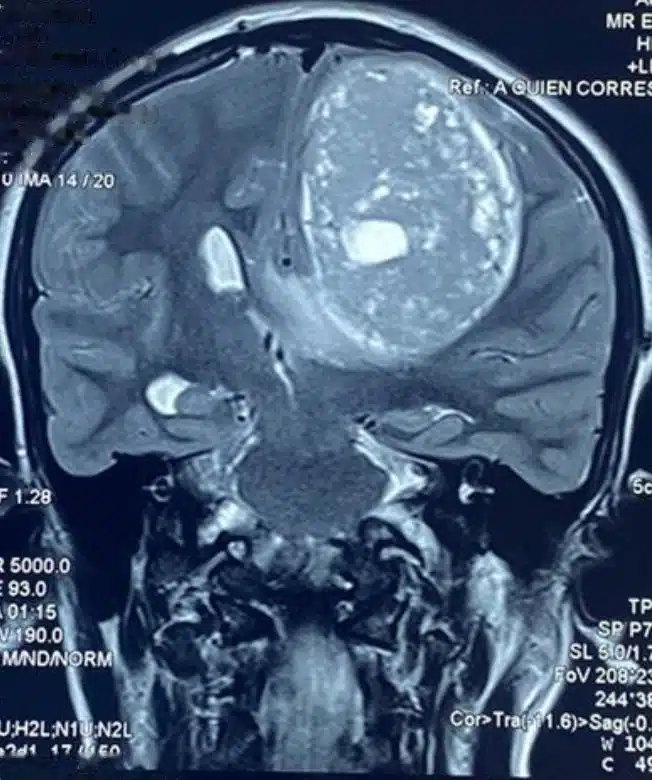
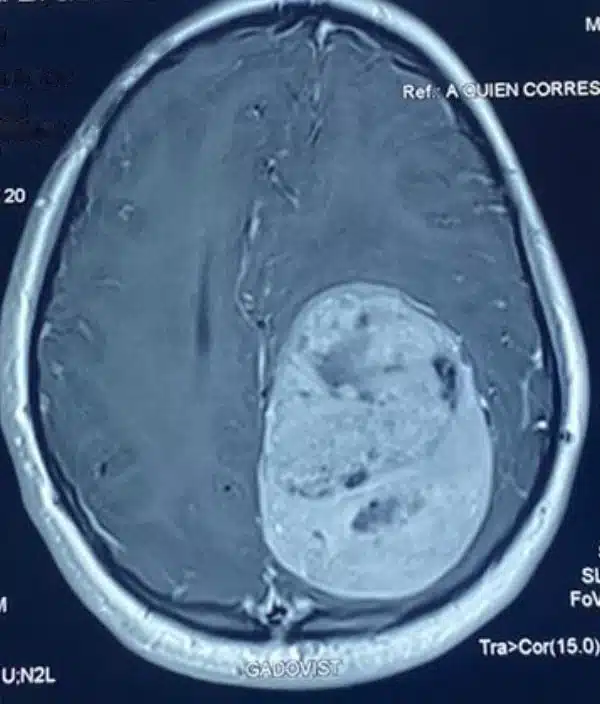
Advanced MRI techniques help plan treatment: spectroscopy analyzes the tissue’s chemical makeup, perfusion measures its blood flow, and tractography shows the path of nearby nerve fibers.
A CT scan is faster and is often used in the emergency room. It is useful for detecting bleeding, calcifications, or involvement of the skull bone.
How do I know if a tumor is benign or malignant?
Whether a tumor is benign or malignant is confirmed by examining the tissue under a microscope. An MRI can suggest the type of tumor, but it cannot confirm it.
The sample is obtained during surgery or, if the tumor is deep, through a stereotactic biopsy: a procedure guided by three-dimensional coordinates that takes a small sample through a tiny opening in the skull.
A neuropathologist, a specialist in analyzing nervous system tissue, examines the sample and runs molecular tests to identify the tumor’s genetic changes. This information defines the type, the grade, and the next steps in treatment.
What if a tumor was found by chance?
A tumor found by chance does not always need immediate treatment, but it does need an evaluation by a neurosurgeon. These findings, called incidental findings, are common when an MRI is done for another reason, such as a head injury or dizziness.
Many are small, benign tumors, such as some meningiomas, that can be monitored with regular MRI scans. The consultation helps interpret the finding, decide whether to monitor or treat it, and set how often to repeat the scans.
What are the treatment options for a brain tumor?
Brain tumor treatment options include active monitoring, surgery, radiation therapy, and chemotherapy, which are often combined. The choice considers the tumor’s type and grade, size, location, symptoms, and the patient’s overall health.
For malignant tumors, the plan is developed together with medical oncology and radiation oncology.
| Treatment | What it involves | When it is considered |
|---|---|---|
| Active monitoring | Regular MRI scans to track tumor size | Small, benign tumors that cause no symptoms and are not growing |
| Surgery | Removing as much of the tumor as safely possible | Tumors that cause symptoms, are growing, or need a confirmed diagnosis |
| Radiation therapy and radiosurgery | Targeted radiation to stop tumor growth | Malignant tumors, residual tumor, hard-to-reach areas |
| Chemotherapy | Medications that act on tumor cells | High-grade gliomas and other malignant tumors |
Minimally Invasive Brain Tumor Surgery
Surgery is the main treatment for most brain tumors that cause symptoms. It aims to remove as much of the tumor as possible without affecting neurological function, obtain tissue for diagnosis, and relieve pressure inside the skull.
Most of these tumors are removed through a craniotomy, which follows three stages:
Step 1
Opening
A section of the skull bone is temporarily removed.
Step 2
Removal
The surgeon reaches the tumor under the microscope and removes it.
Step 3
Closure
At the end, the bone is secured back in its original place.
Dr. García Zamarrón follows the principle of minimally invasive surgery, which aims to reach the tumor while disturbing as little healthy tissue as possible. To do this, he uses neuronavigation, a system that works like a GPS for the brain; fluorescence, which makes the tumor’s borders visible; and neuromonitoring, which tracks movement and sensory pathways in real time.
When the tumor is close to the areas that control speech or movement, the procedure may be done with the patient awake during the removal stage. For pituitary adenomas, the surgeon reaches the tumor through the nose with an endoscope, with no visible incisions.
Explicamos cada etapa de la intervención en nuestro artículo craneotomía: procedimiento y recuperación. También puede conocer los padecimientos que trata el doctor en la página de cirugía de tumores cerebrales.
Risks of surgery
Like any operation, brain tumor surgery carries risks, which your neurosurgeon will review with you before the procedure. General risks include reactions to anesthesia, bleeding, and infection
Risks specific to brain surgery include brain swelling (edema), seizures, cerebrospinal fluid leaks, and new weakness or speech problems, which may be temporary or permanent. How likely these are depends on the tumor’s location and the patient’s overall health.
Radiation therapy and radiosurgery
Radiation therapy uses targeted radiation to damage the genetic material of tumor cells and stop their growth. It can be given in several short sessions over a few weeks or in a single high-precision session called radiosurgery.
It is used for malignant tumors after surgery, for residual tumor that could not be safely removed, and for some small tumors in hard-to-reach areas.
Chemotherapy and medications
Chemotherapy uses medications, taken by mouth or given through a vein, that act on tumor cells. It is mainly used for high-grade gliomas, together with radiation therapy, and is prescribed by a medical oncologist.
Supportive medications include corticosteroids to reduce swelling around the tumor and anti-seizure medications for patients who have had seizures.
Does every brain tumor need surgery?
Not every brain tumor needs surgery. Some can be monitored with regular MRI scans, and others are better treated with radiation therapy.
- Active monitoring: an option for small tumors with benign characteristics that cause no symptoms and show no growth between scans.
- Surgery: considered when the tumor causes symptoms, grows, compresses important structures, or its type needs to be confirmed.
- Other treatments: radiosurgery is an alternative for some small tumors in hard-to-reach areas, and radiation therapy and chemotherapy complement surgery for malignant tumors.
If you were advised to monitor the tumor, follow-up is part of your treatment. If the tumor grows or symptoms appear, the plan is reviewed.
Active monitoring
Follow-up with regular imaging.
Surgery
Tumor removal or biopsy, depending on the case.
Radiation therapy
Targeted radiation to the tumor.
Medication
Treatment based on the diagnosis.
What is recovery like after brain tumor surgery?
After a craniotomy for a brain tumor, recovery moves through several stages:
First hours
Close monitoring
During the first hours, the patient is closely monitored. Pain is managed, patients are encouraged to start moving early, and a follow-up MRI is done to evaluate the result of surgery.
About 3 days
Hospital stay
As a general reference, the hospital stay after a craniotomy for a brain tumor is about 3 days.
Depending on the case
Rehabilitation
Some patients need physical, speech, or occupational therapy to regain functions affected by the tumor or the surgery.
2 to 4 weeks
Return to daily activities
Most people return to their usual daily activities 2 to 4 weeks after surgery. Every patient recovers at their own pace.
After discharge
Follow-up care
Follow-up continues after you leave the hospital, with regular appointments and MRI scans to detect any change early, since some tumors can come back even after complete removal.
Long term
Outlook
Long-term outlook depends mainly on the tumor’s type and grade and on how much of it could be removed. Many benign tumors that are completely removed can be controlled long term; for malignant tumors, combined treatment aims to control the disease and preserve quality of life.
Key takeaways
- Not every brain tumor is cancer: many are benign.
- A benign brain tumor may still need treatment, because its growth inside the skull can press on delicate structures.
- Symptoms depend on the tumor’s location; sudden or severe symptoms need emergency care.
- An MRI detects the tumor, and tissue analysis confirms whether it is benign or malignant.
- Not every tumor needs surgery: treatment may include monitoring, surgery, radiation therapy, or chemotherapy.
Frequently asked questions about brain tumors
I just received a diagnosis. What information do I need to know?
Four things are worth understanding clearly: the type of tumor, its grade, its location, and the treatment options for your case. The type and grade describe how the tumor behaves; the location shows which functions may be affected and how accessible the tumor is. With this information, it is easier to compare options and make decisions with confidence.
I get frequent headaches. Could it be a brain tumor?
Most frequent headaches are migraines or tension headaches, not tumors. It is worth seeing a doctor if the headache is new, changes in character, gets worse over weeks, or comes with vomiting, vision changes, weakness, or seizures.
Can a benign brain tumor come back?
Yes, in some cases. Complete removal of a benign tumor often provides long-term control, but it can come back. That is why regular follow-up MRI scans are part of treatment.
How long is recovery after brain tumor surgery?
As a general reference, the hospital stay is about 3 days, and most people return to their daily activities 2 to 4 weeks later. The exact timing depends on the tumor type, its location, and the patient’s overall health.
Why would I have surgery while awake?
Awake brain surgery is recommended when the tumor is close to the areas that control speech or movement. Keeping the patient awake during removal allows the team to confirm in real time that these functions are preserved. You do not feel pain, because the brain has no pain receptors and the scalp is numbed beforehand.
Can a brain tumor be prevented?
In most cases, no, because brain tumors arise from genetic changes that do not depend on lifestyle habits. Avoiding unnecessary radiation to the head is the only documented environmental factor that can be controlled.
I already have a diagnosis. Can I get a second opinion?
Yes. Getting a second opinion is your right and a common step before brain surgery. For your visit, bring your imaging studies in digital format, the radiology reports, and, if available, the pathology report.
Consultation & Evaluation
Schedule Your Evaluation
If you have a brain tumor diagnosis or neurological symptoms that will not go away, a specialist evaluation gives you something concrete: understanding what you have, what options exist, and whether your case requires surgery. Dr. García Zamarrón sees patients at Hospital Ángeles in Ciudad Juárez, just across the border from El Paso, Texas.
Schedule Your Consultation Message Us on WhatsAppDr. José Raúl García Zamarrón —Neurosurgeon · Brain & Spine
Av. Campos Elíseos 9371, Office 795, Col. Campos Elíseos, C.P. 32420, Ciudad Juárez, Chihuahua
Phone 656 227 1963 WhatsApp 656 657 7818
Monday to Friday, 9:00 AM–5:00 PM · Saturdays, 9:00 AM–12:00 PM
Keep Reading
Medical Review
Dr. José Raúl García Zamarrón
Neurosurgeon · Brain & Spine · Ciudad Juárez, Chihuahua
Mexican medical license: 6241285
Specialty license: 10138902
Certified by the Mexican Council of Neurological Surgery
Member of AO Spine and EANS
Learn about the specialist’s background →
Last updated: October 2026.
Medical disclaimer
This content is for informational and educational purposes only. It does not replace a medical consultation, diagnosis, or personalized treatment. If you have neurological symptoms, see a specialist. If they are sudden or severe, seek emergency medical care.